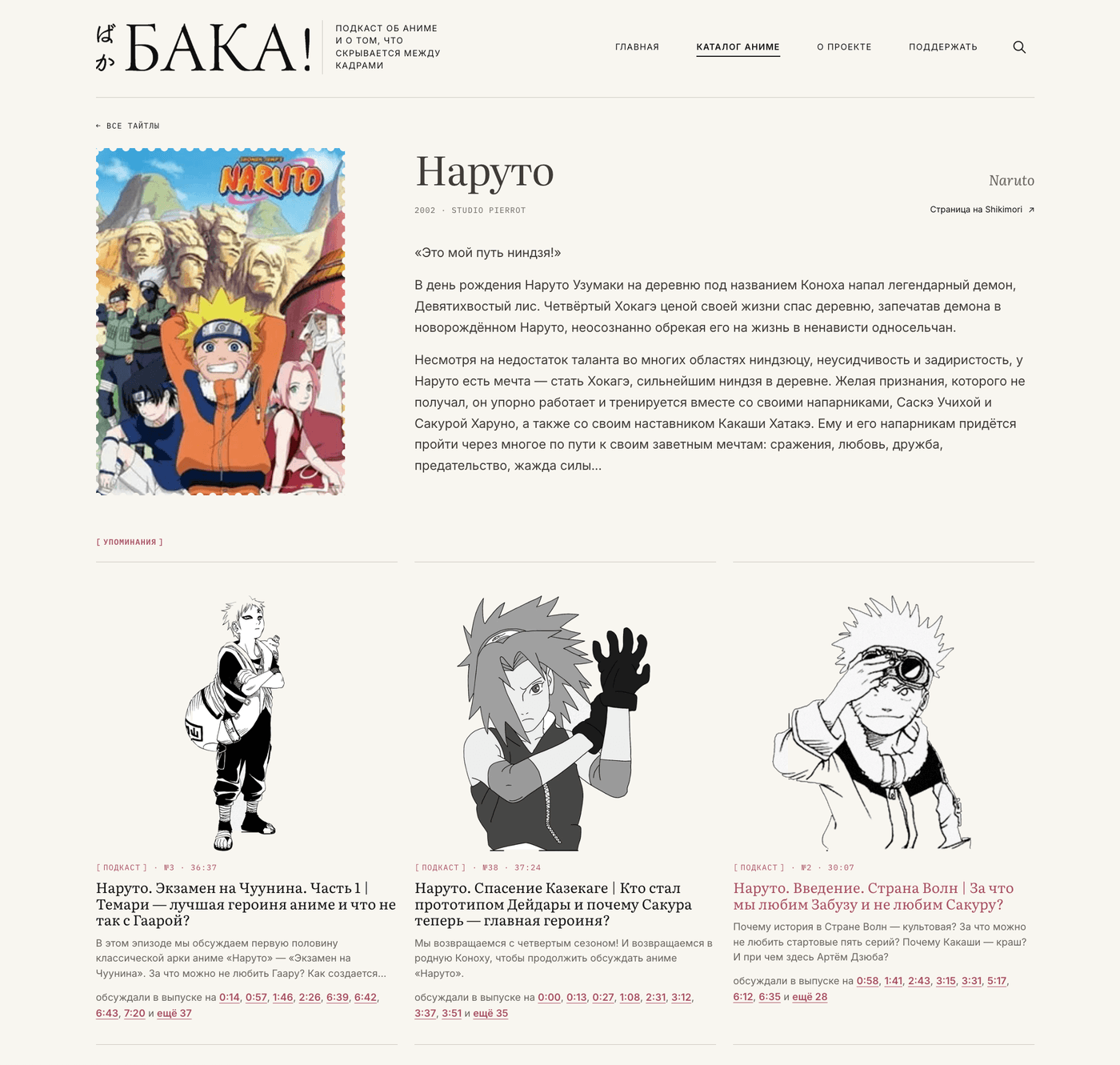
Baka! website
- Built in 11 days
- 143 episodes transcribed
- 9 bots keep it updated
A full archive of a six-year anime podcast — every episode, post and article, linked to a catalogue of 500+ anime titles down to the minute they're mentioned.
Why
Baka! had been running for six years. What started as two beginners talking about anime grew into a media project: a daily Telegram channel, video essays on YouTube, 120,000 followers on TikTok. And all of it lived inside social networks. Six years of conversations about anime that no search engine, and no AI, could find.
I had tried once before, a year and a half earlier, to build a site with ChatGPT. I got as far as buying a domain and gave up: too much had to be done by hand, and I hadn’t written a line of code since Pascal in seventh grade.
What I did
This time I started with planning, not code. I asked Claude to interview me about what I wanted, and out of that came the idea that shaped the whole site: two halves, an archive of everything we’ve made and a catalogue of anime titles, joined by mentions. Click on any anime and you see everything we’ve ever said about it — in posts, in articles, in podcast episodes down to the minute.
Claude proposed the stack (Astro, a git-based CMS, Cloudflare) and wrote the first specs; Claude Code built them. My job was to be the product owner in between: write the spec, review the result, decide what was next. The one trick that kept the project alive was asking Claude Code to write a report after every session, so the next session could start from a document instead of my memory.
I designed the site separately, as HTML mockups, before handing it over to code. That took one evening. Making the code match the mockups took two days — a mockup shows one state of a page, a real site needs all of them.
The last week was about the content. I transcribed 143 episodes, imported about a thousand Telegram posts, and wrote nine small bots so I would never have to do it by hand again: one watches the podcast feed, one transcribes new episodes and tells the hosts apart by voice, one cuts the character out of each cover, one imports posts from Telegram, others match titles in the text and build catalogue pages from AniList data. Only two of the nine call an AI; the rest is plain code.
What came out
The site went live on 14 August 2026 with 143 episodes, close to a thousand posts and a catalogue of 507 titles with 14,286 cross-references. Because it’s a static site, a copy of it runs on Yandex Cloud for readers in Russia, where Cloudflare is blocked. The whole build cost around 12,000 rubles — about €130, mostly AI subscriptions.
Today my work on the site is checking drafts the bots have prepared and pressing publish.